
Skip to content

Agency with its own platform

A system that finds, attracts and converts customers. And we run it with you.

No more relying on one-off efforts. We build your company's customer acquisition system and run it alongside you, on our own platform, where we show you the work.

01 · Find · our own Signal Engine

We know who to talk to, and why.

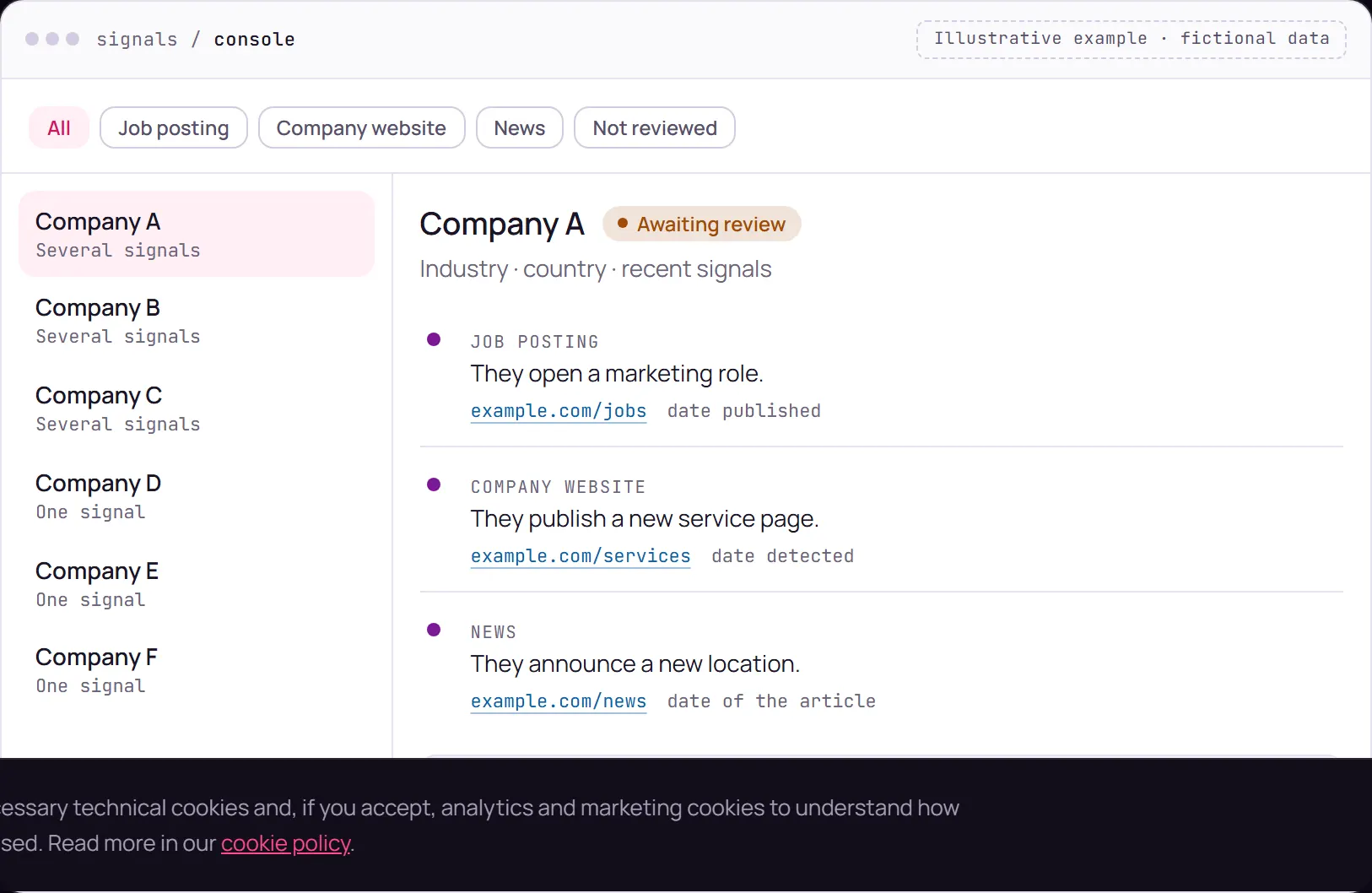
Our Signal Engine reads public sources and spots companies at a moment when what you offer is useful to them: an open role, a new service, a new location.

Every data point comes with its source and its date. A person reviews it before we propose a contact to you.
02 · Attract

Be found by people already looking.

Ads, search, content and your website work as one: whoever searches for what you do lands on a page built for that search.

03 · Talk

Every contact, followed up.

Scattered signals become organized conversations. Every contact has a stage and a next step, so follow-up no longer depends on someone remembering.

04 · Convert

From conversation to customer.

Not every conversation ends in a customer. The system is there so they don't slip away through neglect, and so you know where each one stands.

Symbolic diagram · does not represent results

05 · Our own platform

The work stays in plain sight.

Campaigns, content and contacts run through one place. Today we show it to you in reports by link; read-only client access is in development.

See inside the platform
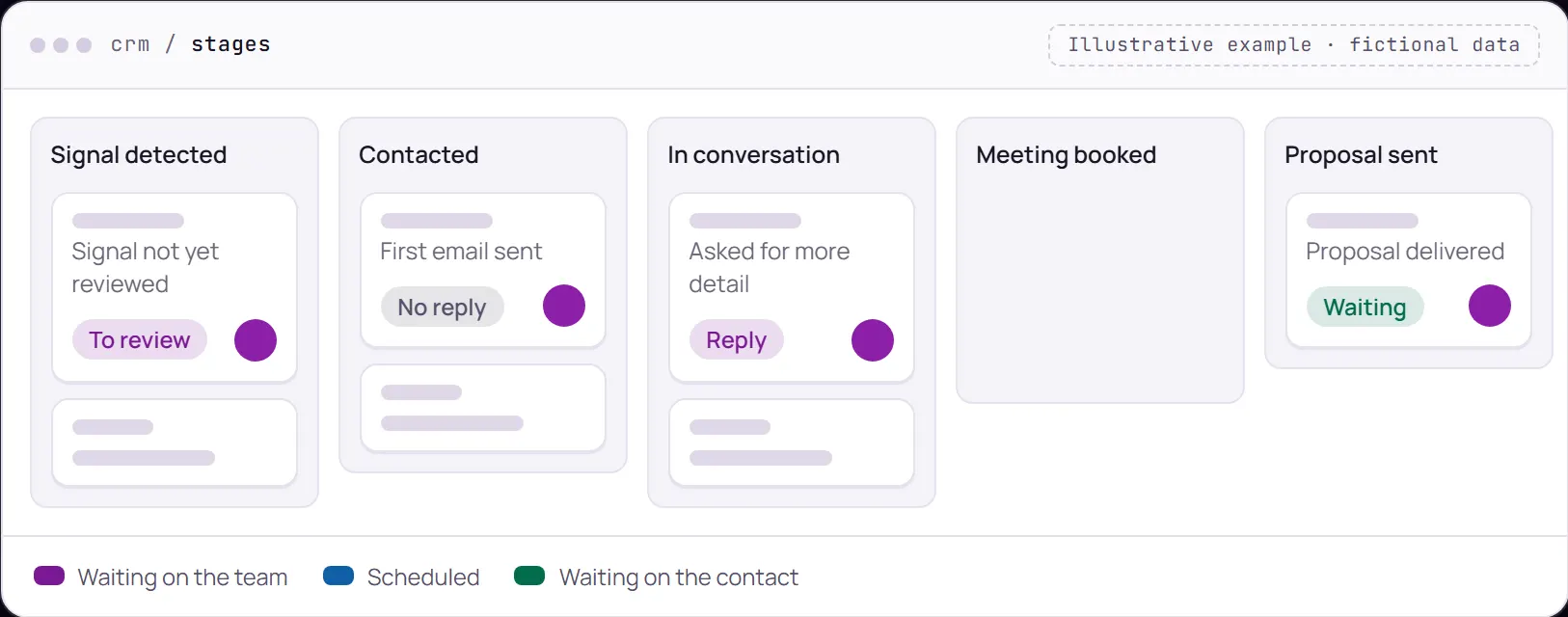
Illustrative example of the pipeline by stage: five columns, from signal detected to proposal sent, with the companies in each stage. Fictional data.Illustrative example of the pipeline by stage: five columns, from signal detected to proposal sent, with the companies in each stage. Fictional data.

06 · Specialists by area

And we run it with you.

Behind the system are specialists in each area, and one point of contact for you.

  • Strategy and marketingDecides with you who to reach and which pieces to start with.
  • Advertising and SEOGoogle and Meta campaigns and search visibility.
  • Content and socialArticles, guides and posts that answer doubts.
  • Automation and AIAgents, email sequences and documented processes.
  • Product and developmentThe platform, the website and the systems that hold the work up.
  • Operations and client careEach week's follow-up and a single point of contact.
Symbolic diagram of the systemThree stages from left to right: scattered signals, conversations arranged in rows, and a few customers.SignalsConversationsCustomers
Illustrative example · symbolic diagram, does not represent results

The platform

Everything runs through one place. And we show it to you.

  1. 01Account record

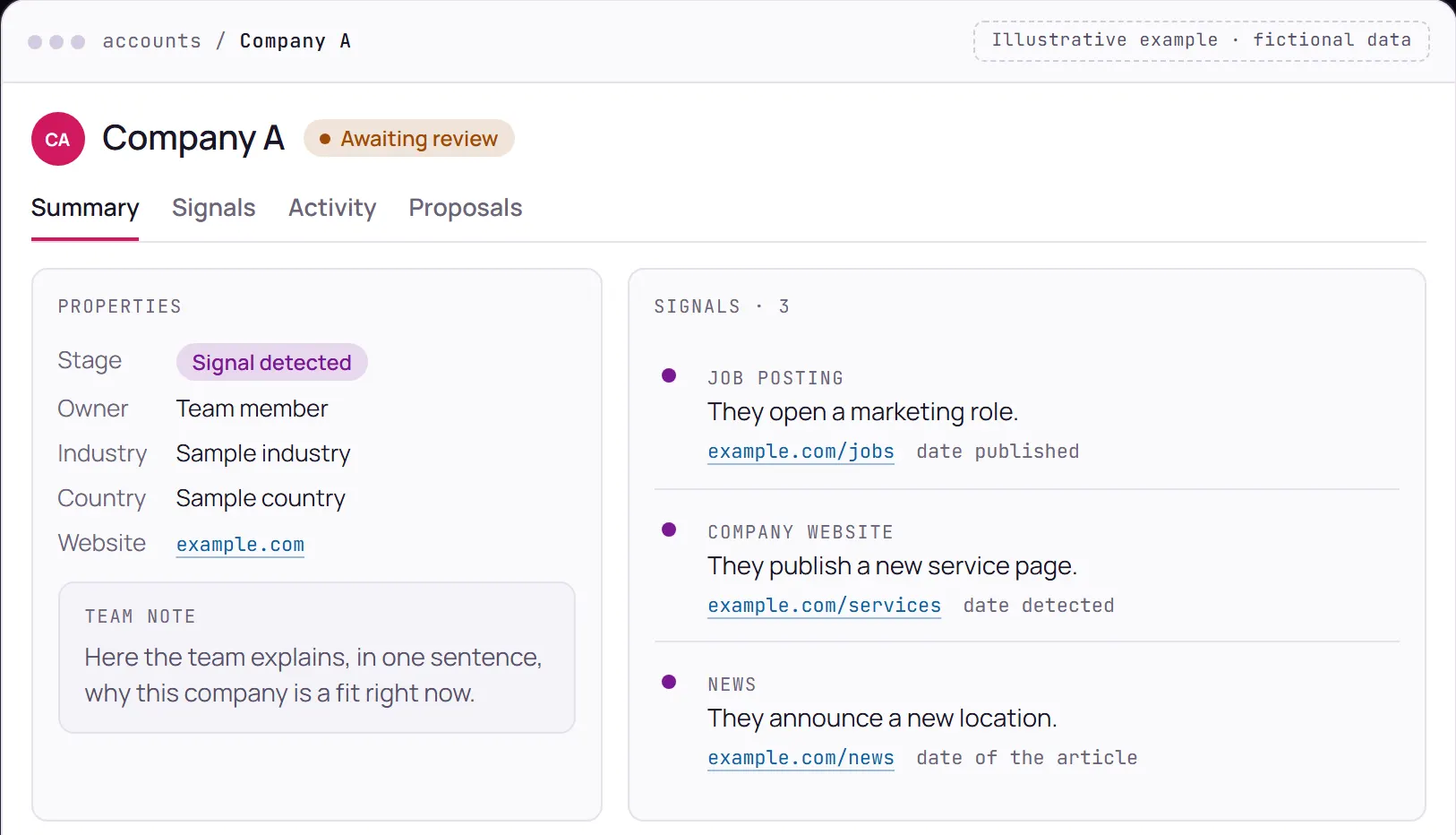
    A record gathers what we know about a company and where it comes from. The pattern is always the same: what was detected, in which source, on what date. Activity is logged below, in order.

    What the team does Reviews the signals and writes the note explaining why it's a fit.

    What you do or see You read the reason before anyone gets a message.

  2. 02Review queue

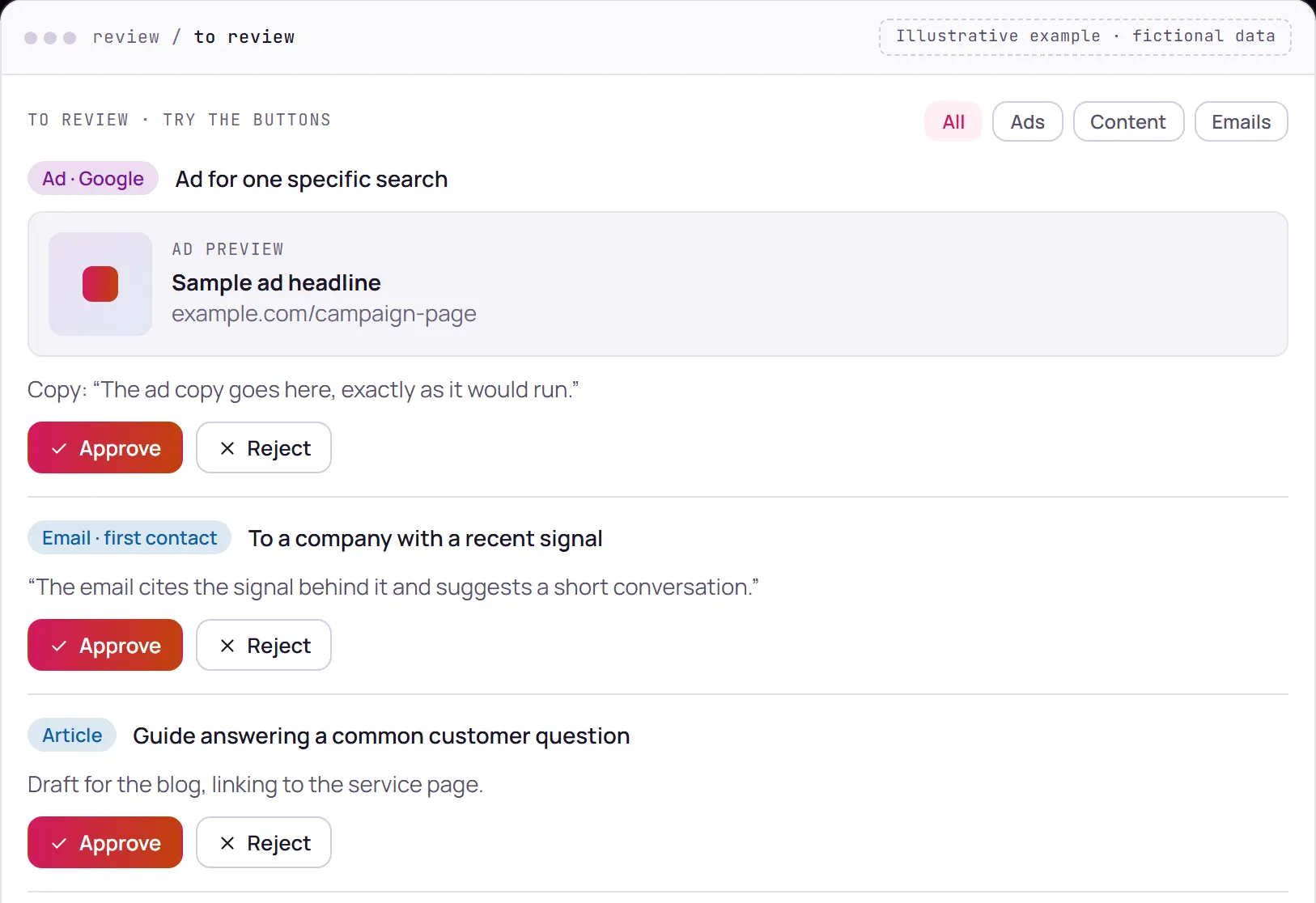
    Ads, articles, posts and emails can go through a review queue, where a person approves or rejects each piece.

    What the team does Prepares each piece and leaves it ready for review.

    What you do or see With review switched on, you approve or reject anything that carries your name, with your point of contact.

  3. 03Pipeline by stage

    Companies move across columns, from first signal to proposal. At a glance you can see what's stalled and whose move it is.

    What the team does Moves each contact from stage to stage and notes the next step.

    What you do or see You know where every conversation stands.

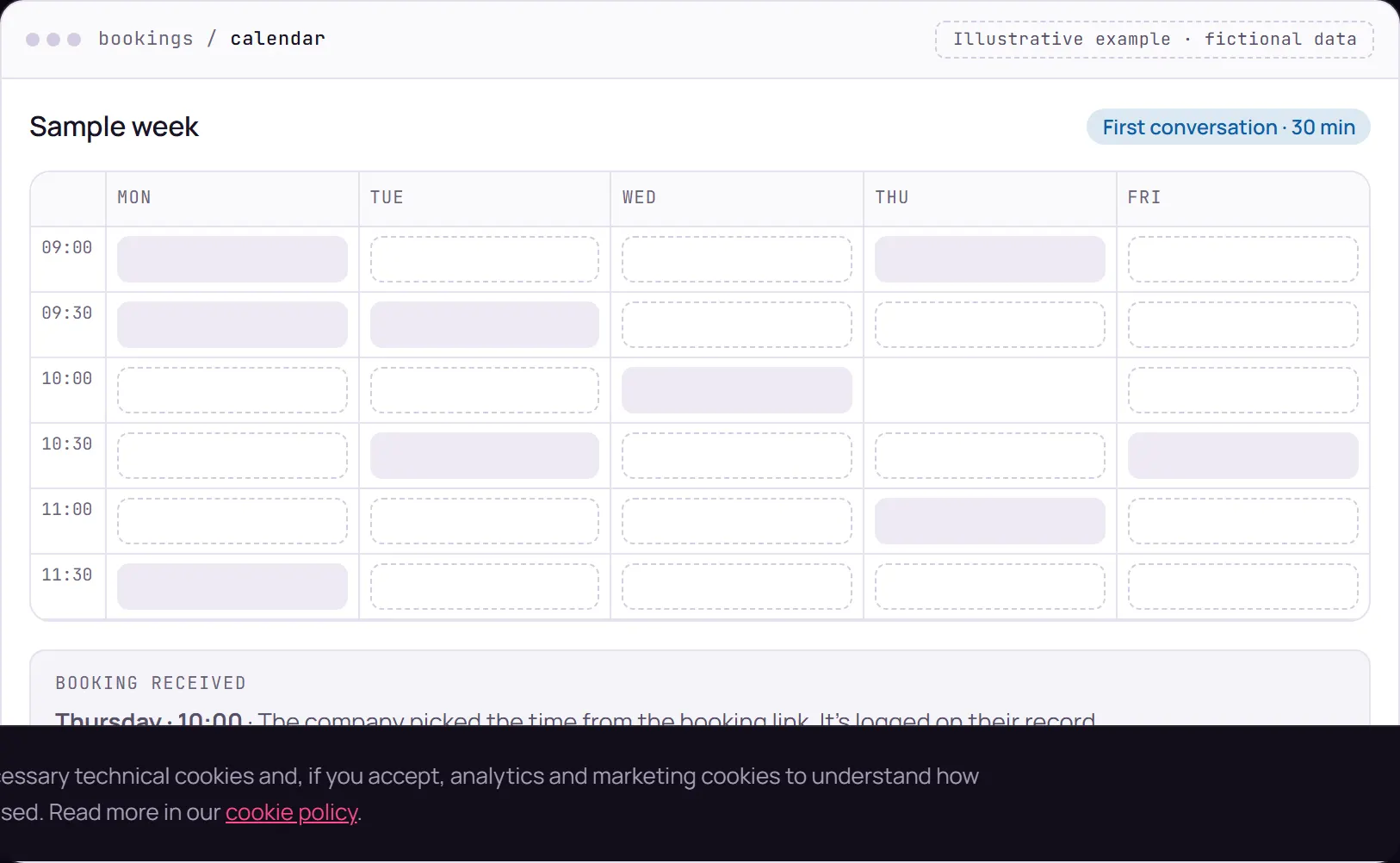
  4. 04Booking calendar

    Whoever wants to talk opens a link, sees the open times and books one. The meeting shows up on the calendar and on their company's record.

    What the team does Sets up the meeting types and keeps availability current.

    What you do or see You get the meeting already on the calendar.

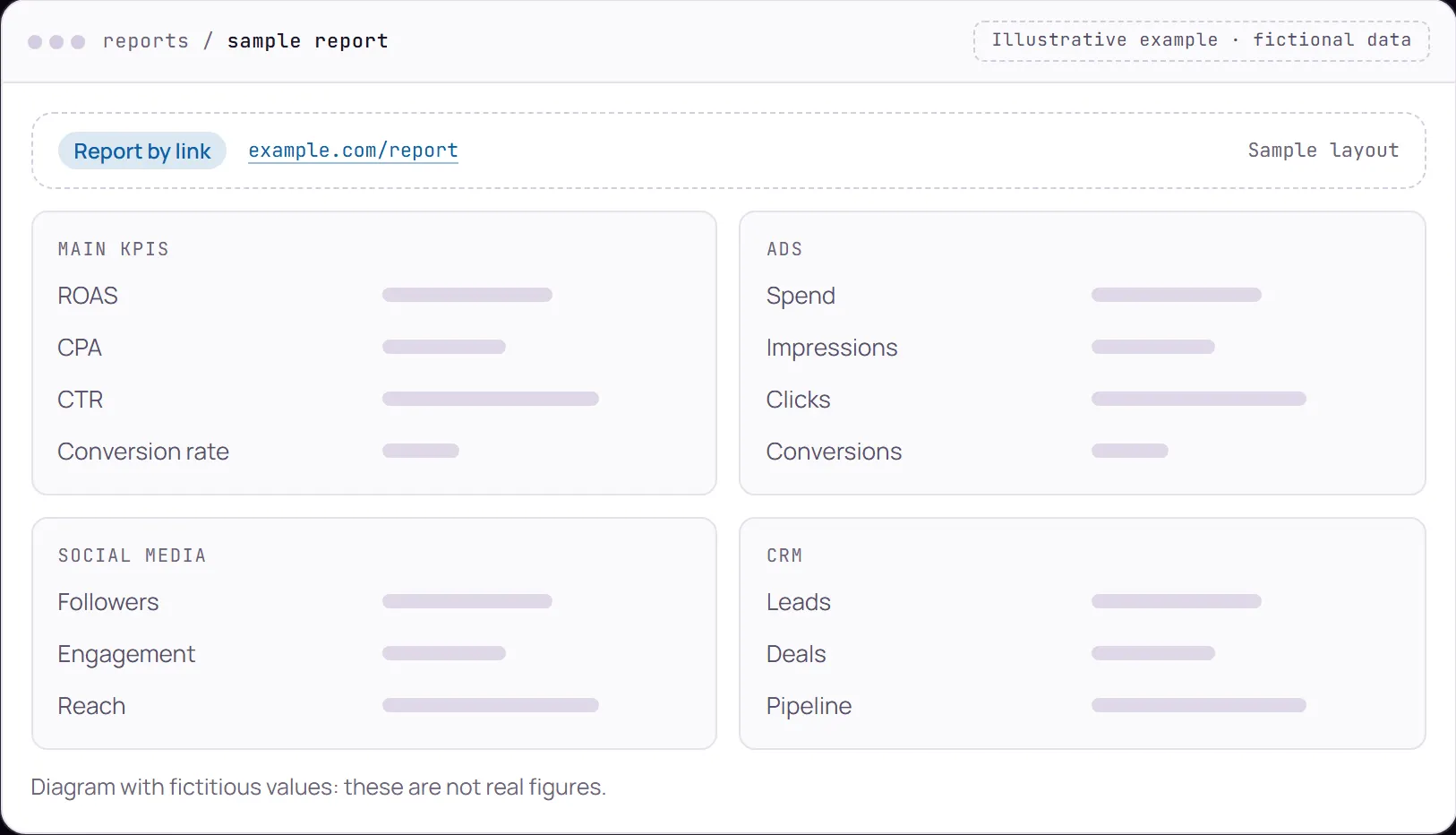
  5. 05Report by link

    A report that opens from a link, with nothing to install: main KPIs, ads, social media and CRM.

    What the team does Prepares it and shares it by link.

    What you do or see You open it whenever you like, no need to ask.

  6. 06Signal console

    The Signal Engine gathers what it finds in public sources and sorts it by company. The rule is simple: if a data point has no link and no date, it doesn't get in.

    What the team does Filters, checks every source and decides what moves on to outreach.

    What you do or see You see the evidence behind every company we suggest.

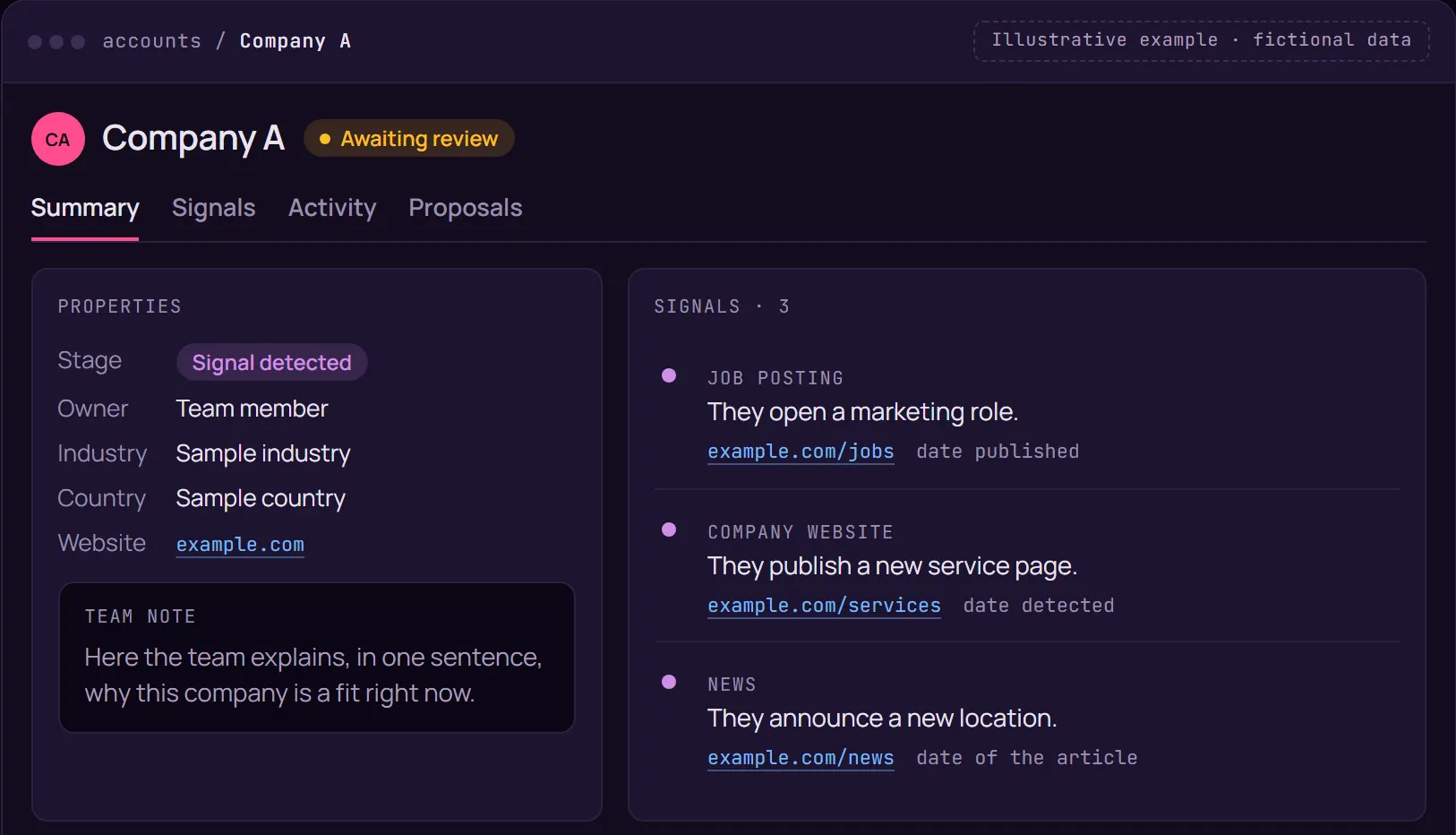
Illustrative example of an account record: company properties, three signals with source and date, and activity in order. Fictional data.Illustrative example of an account record: company properties, three signals with source and date, and activity in order. Fictional data.

A record gathers what we know about a company and where it comes from. The pattern is always the same: what was detected, in which source, on what date. Activity is logged below, in order.

Review queueReview queue

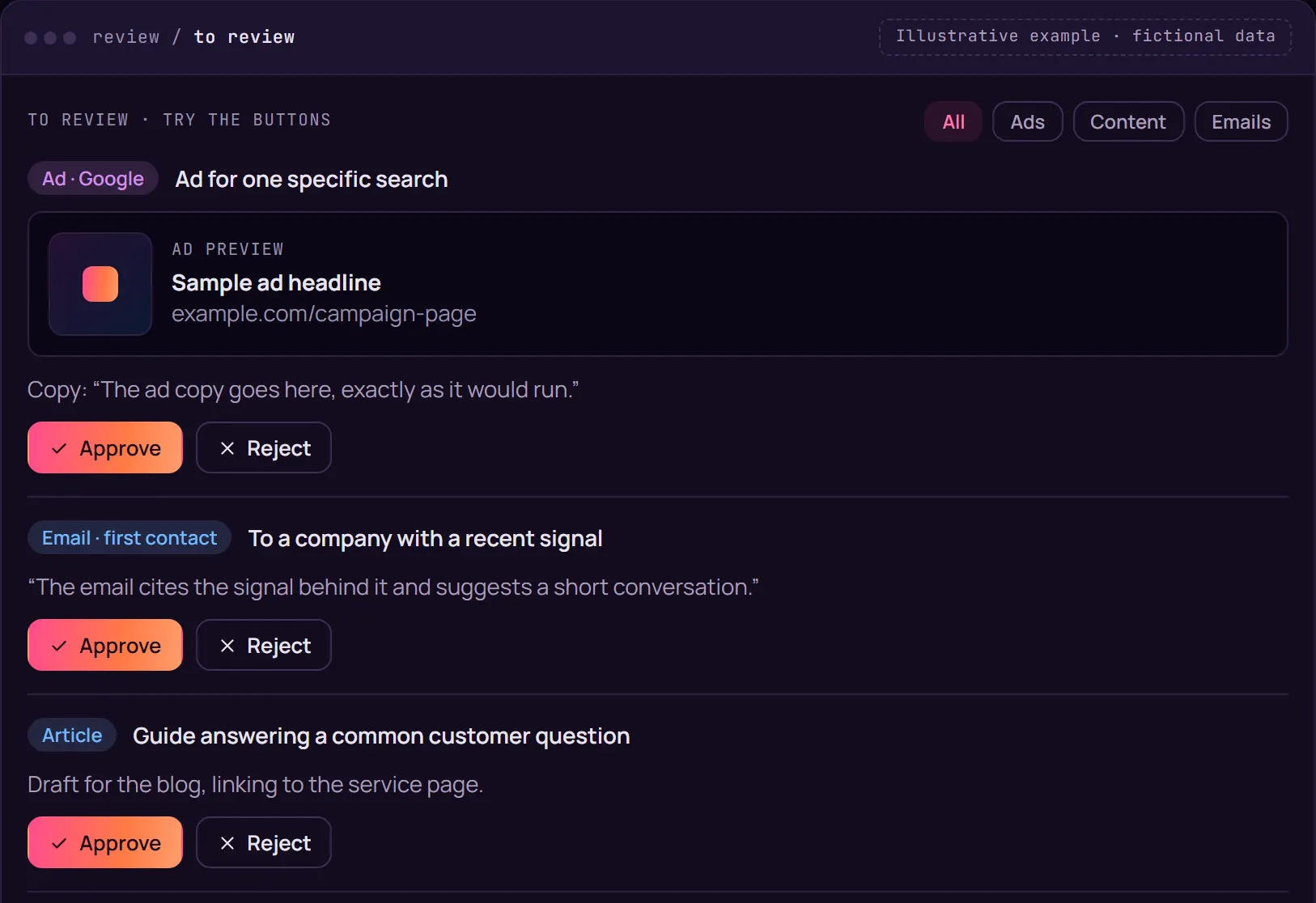
Ads, articles, posts and emails can go through a review queue, where a person approves or rejects each piece.

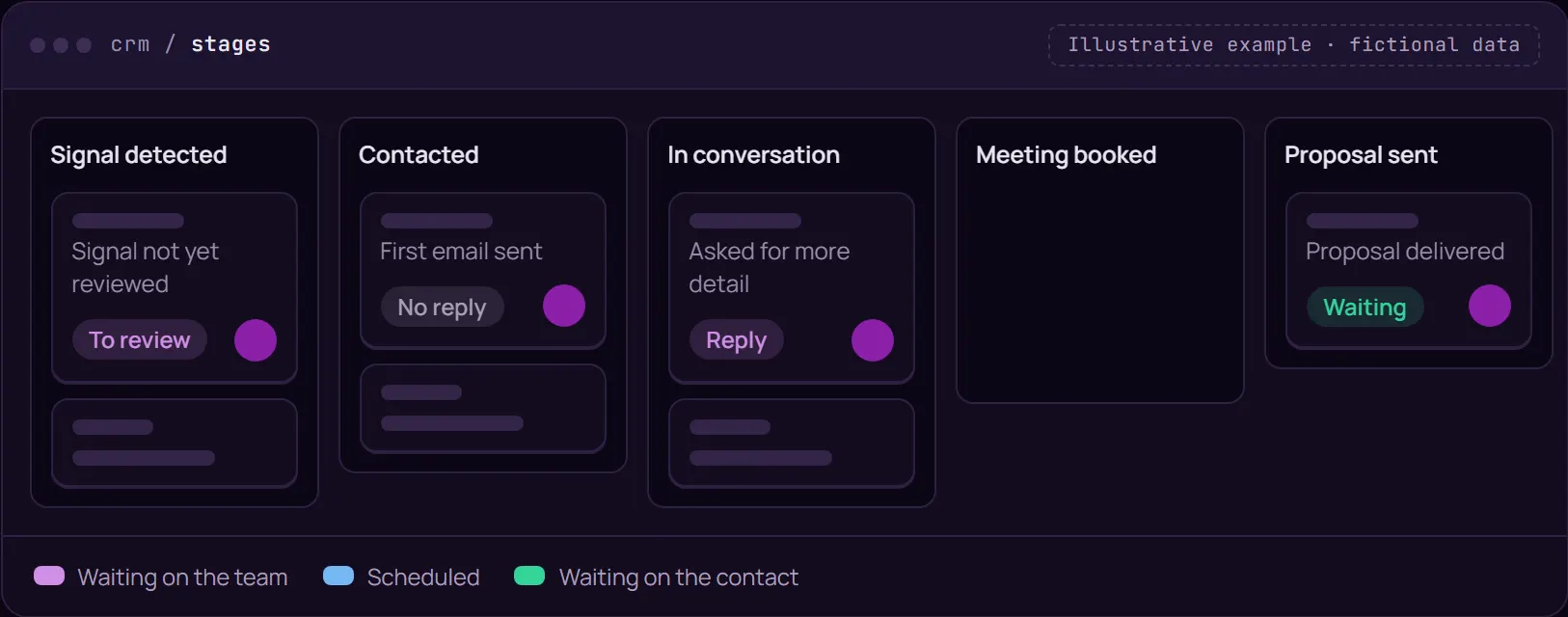
Illustrative example of the pipeline by stage: five columns, from signal detected to proposal sent, with the companies in each stage. Fictional data.Illustrative example of the pipeline by stage: five columns, from signal detected to proposal sent, with the companies in each stage. Fictional data.

Companies move across columns, from first signal to proposal. At a glance you can see what's stalled and whose move it is.

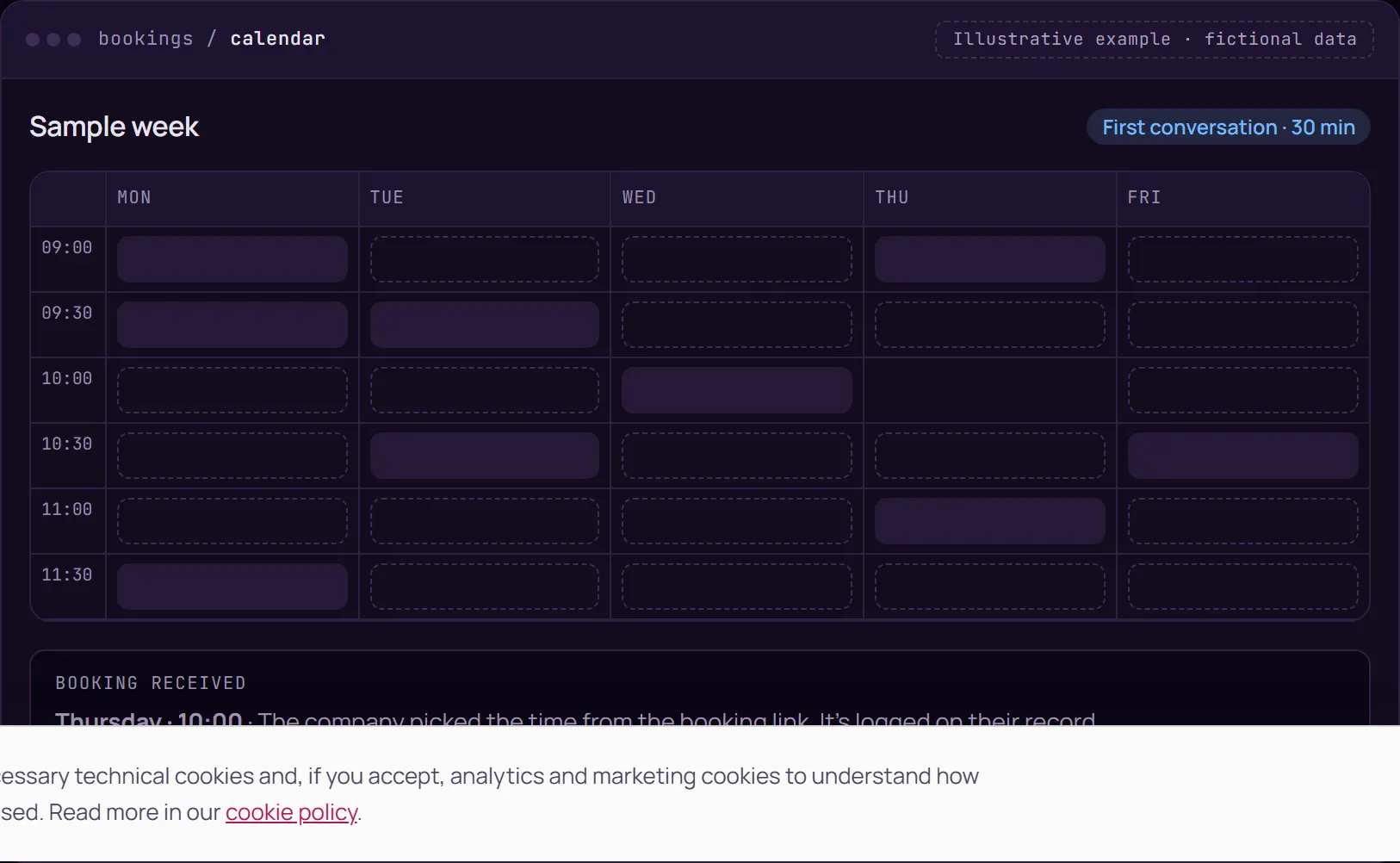
Illustrative example of the booking calendar: a week with open times, busy times and one 30-minute meeting booked. Fictional data.Illustrative example of the booking calendar: a week with open times, busy times and one 30-minute meeting booked. Fictional data.

Whoever wants to talk opens a link, sees the open times and books one. The meeting shows up on the calendar and on their company's record.

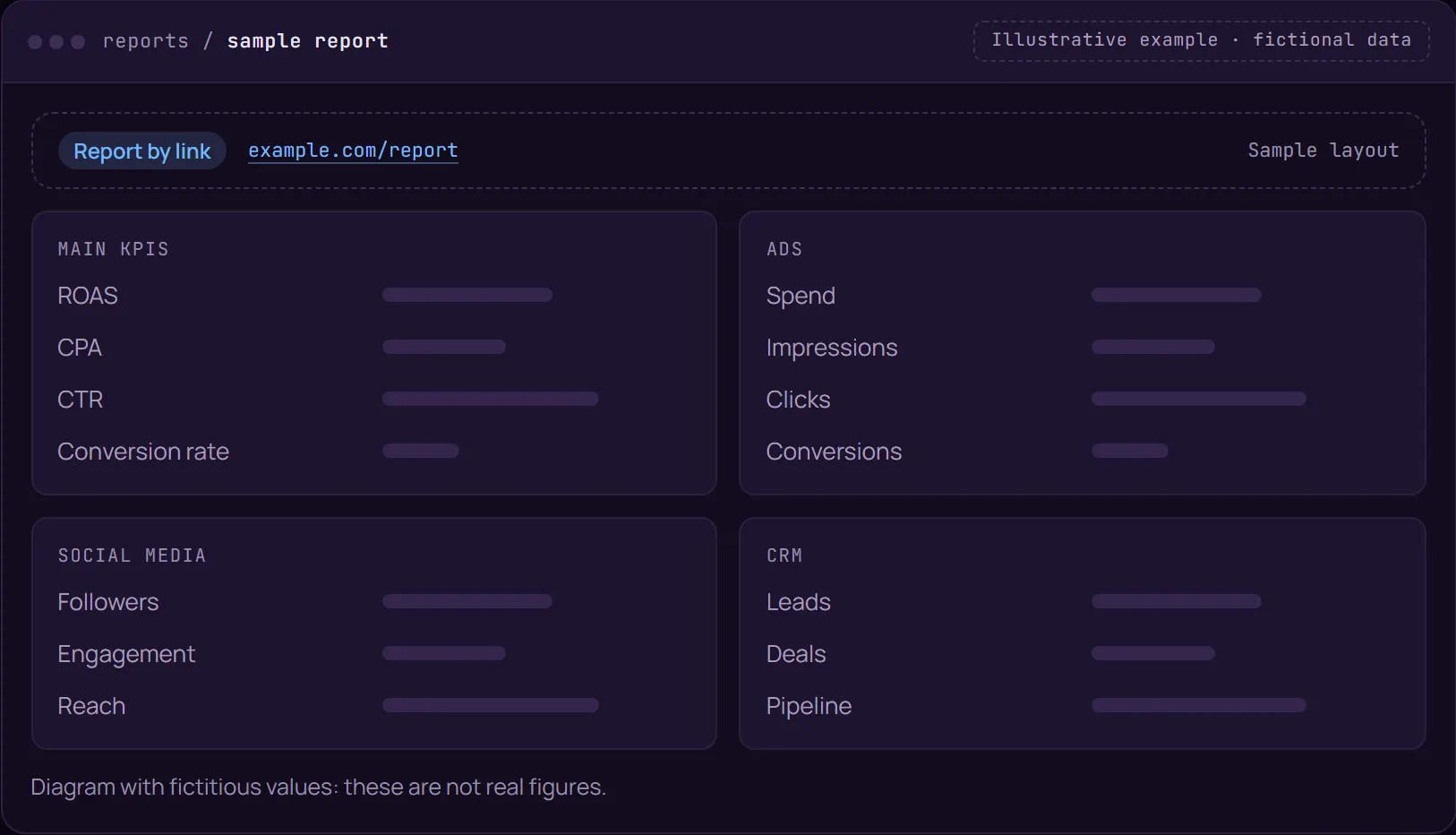
Illustrative example of a report by link with metrics: main KPIs, ads, social media and CRM. Diagram with fictitious data.Illustrative example of a report by link with metrics: main KPIs, ads, social media and CRM. Diagram with fictitious data.

A report that opens from a link, with nothing to install: main KPIs, ads, social media and CRM.

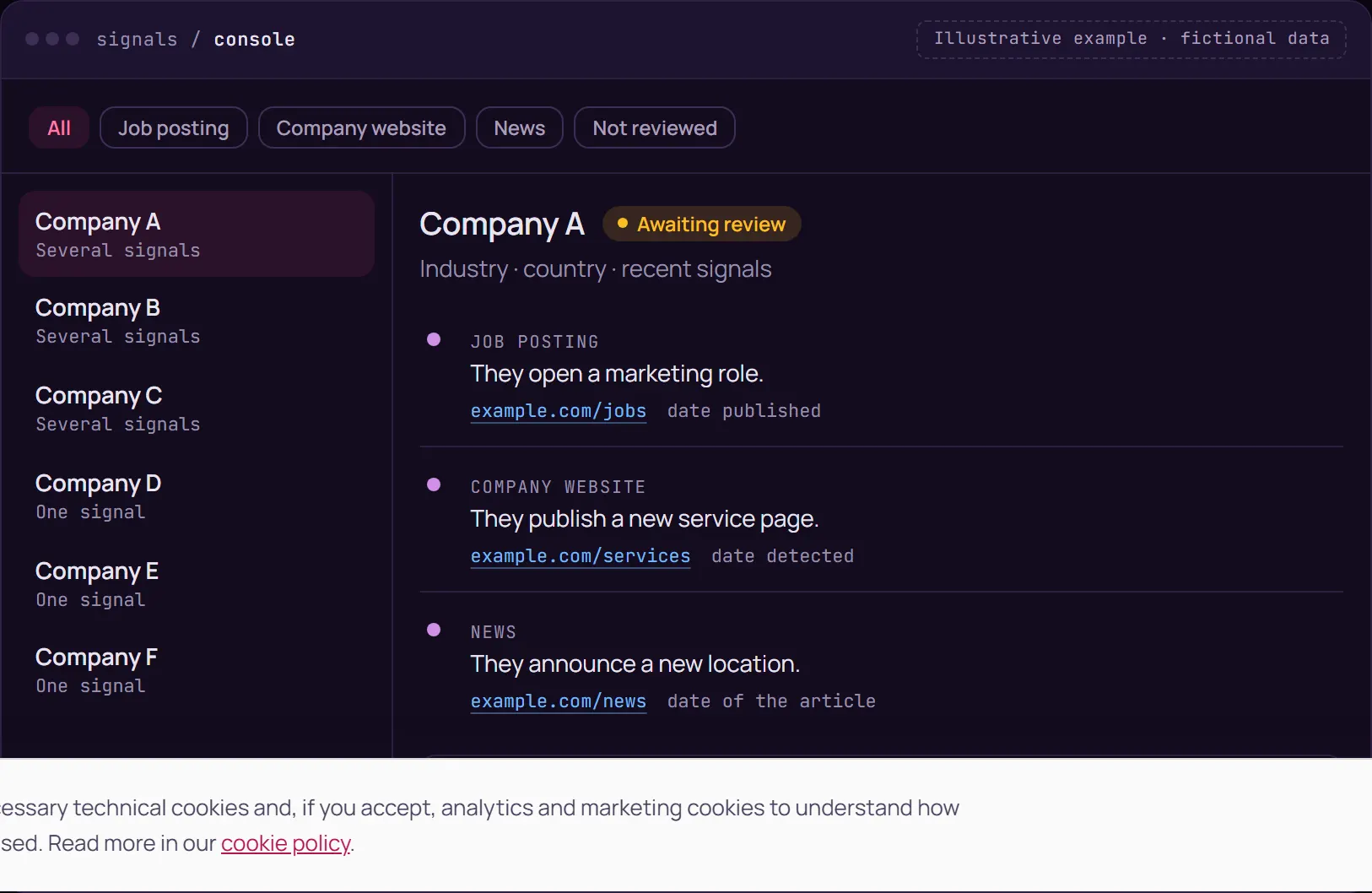
Illustrative example of the signal console: filters by signal type, a list of accounts and, for the selected account, each signal with its source, link and date. Fictional data.Illustrative example of the signal console: filters by signal type, a list of accounts and, for the selected account, each signal with its source, link and date. Fictional data.

The Signal Engine gathers what it finds in public sources and sorts it by company. The rule is simple: if a data point has no link and no date, it doesn't get in.

01 · Account record

A record gathers what we know about a company and where it comes from. The pattern is always the same: what was detected, in which source, on what date. Activity is logged below, in order.

Illustrative example of an account record: company properties, three signals with source and date, and activity in order. Fictional data.Illustrative example of an account record: company properties, three signals with source and date, and activity in order. Fictional data.
Screen 01 · Account record · Illustrative example · fictional data

02 · Review queue

Ads, articles, posts and emails can go through a review queue, where a person approves or rejects each piece.

Screen 02 · Review queue · Illustrative example · fictional data

03 · Pipeline by stage

Companies move across columns, from first signal to proposal. At a glance you can see what's stalled and whose move it is.

Illustrative example of the pipeline by stage: five columns, from signal detected to proposal sent, with the companies in each stage. Fictional data.Illustrative example of the pipeline by stage: five columns, from signal detected to proposal sent, with the companies in each stage. Fictional data.
Screen 03 · Pipeline by stage · Illustrative example · fictional data

04 · Booking calendar

Whoever wants to talk opens a link, sees the open times and books one. The meeting shows up on the calendar and on their company's record.

Illustrative example of the booking calendar: a week with open times, busy times and one 30-minute meeting booked. Fictional data.Illustrative example of the booking calendar: a week with open times, busy times and one 30-minute meeting booked. Fictional data.
Screen 04 · Booking calendar · Illustrative example · fictional data

05 · Report by link

A report that opens from a link, with nothing to install: main KPIs, ads, social media and CRM.

Illustrative example of a report by link with metrics: main KPIs, ads, social media and CRM. Diagram with fictitious data.Illustrative example of a report by link with metrics: main KPIs, ads, social media and CRM. Diagram with fictitious data.
Screen 05 · Report by link · Illustrative example · fictional data

06 · Signal console

The Signal Engine gathers what it finds in public sources and sorts it by company. The rule is simple: if a data point has no link and no date, it doesn't get in.

Illustrative example of the signal console: filters by signal type, a list of accounts and, for the selected account, each signal with its source, link and date. Fictional data.Illustrative example of the signal console: filters by signal type, a list of accounts and, for the selected account, each signal with its source, link and date. Fictional data.
Screen 06 · Signal console · Illustrative example · fictional data
See every option on the platform

What it doesn't do on its own: it doesn't decide who's a fit or book meetings on anyone's behalf. There is a review queue where a person approves sends.

Services

The pieces, one by one.

Eleven services in three groups. Start with one; they're built to fit together.

Attract

Acquire

So the people already looking for what you do can find you.

Convert

Respond and automate

So every contact is followed up and repetitive work comes off your team's plate.

Support

Build and train

What's needed behind the scenes to keep the system standing.

We run it with you

What “with you” means.

We do the work, week in, week out. You keep the decisions.

Us

We build and run

  • We set up the pieces your company needs.
  • We work every week: campaigns, content and follow-up.
  • We review every signal before suggesting a contact to you.
  • We show you the work in a report by link.

You

You decide and talk

  • You set the priorities: who you want to reach, and with what.
  • You can approve or reject anything that goes out under your name.
  • You take the meetings with the people who want to talk to you.
  • You have one point of contact for everything.

How we work

If we can't cite it, we don't claim it.

  • Public, checkable sources

    No bought lists, no data without an origin. Every signal links to its source.

  • Your data stays yours

    What you give us is used for your work and nothing else. Per-client isolation inside the platform is in development.

  • A review queue

    Technology proposes and organises. There is a review queue where a person approves sends and posts.

Where it applies · the system isn't tied to one industry

Law firms, clinics, real estate, education and training, e-commerce, hotels and restaurants and tech companies.

Contact

Let's talk for 30 minutes.

Tell us who you want to reach. We'll show you how we'd approach it and which piece to start with.

Illustrative example of the booking calendar: a week with open times, busy times and one 30-minute meeting booked. Fictional data.Illustrative example of the booking calendar: a week with open times, busy times and one 30-minute meeting booked. Fictional data.
Screen 04 · Booking calendar · Illustrative example · fictional data